Monday, April 26, 2021

When Bokeh is a Fancy Name for Intended Blur


Film photography is attempting a renaissance as digital cameras have not always been able to produce that visual feel film has reached in a century of trials. And I do not think it is nostalgia although watching 1940s B&W movies often transports me to that place where I do not need to see colour to live art and artfulness.


I belong to those who still roll their own film, use only mechanical cameras, who have a Hansa Pro enlarger and who after submerging millions of 8x10 papers in the developing tray, and are like a kid on Christmas morning.


Of course a 1948 Rolleiflex TLR cannot do anything a throw away digital camera can do. A 1953 Leica III rangefinder can hardly escape glare and flair. And the meter of 1969 Nikon F Photomic could hardly come close to reading incident light after sunset! Yet, we marvel at what photographers in the 1950s and 1970s were able to produce with mechanical shutters, heuristic light meters and lenses with 7 or less straight blades.


One of the signature collaboration between the photographer and mechanical cameras is the creation of blurred backgrounds also known as bokeh.

O the subject of the photo.


What is bokeh and why do we cherish it?


Simply, it is the purposeful blurring of the background while focusing on a subject. Clearly such a technique is great in portraiture when one wants to “eliminate” the visual distraction any background can create to the printed photo. In other words, it is the manipulation of reality to create an intended reality by making an individual stand out of a crowd, of perhaps a forest behind him or her.


Of course, today’s computerized cameras have many settings one can adjust for the camera and its synchronized wonder lens to create a background blur. But when a 1938 collapsible Leica Summar, designed with only 6 elements of uncoated glass was able to produce the dreamiest bokeh I had seen when I started street photography, one has to wonder about the collaboration between photographer and the lens. Not the camera, but the lens, because it is the lens that produces the blur intended by the photographer.


Is a blur, by any other name, a pleasant bokeh?


No. There is almost a romantic lexicon to describe a blur. It can be creamy, or dreamy. It can be abrupt or harsh. It can yet be distracting or unpleasant. Finally, there seems nothing more nerve wracking then a “heptagonal shapes in the blur” bokeh!


So, this takes us to the difference between a blur and a bokeh. Since the whole concept is an evaluation by the viewer, the subjective nature of the difference is:

                 A bokeh is the quality of the blur, not the blur itself.


Hmm.


To illustrate here are a few bokeh types from my own works, using various lenses and cameras.


A.    Evening market in Morocco


I had a Minolta Autocord TLR as people in the market would ask for payment if they see a tourist lift a camera to their face.

This woman was doing temporary henna tattoos and I saw her creating a design around the belly button of a tourist. I opened the lens to f3.5 and probably at 1/25th second speed as it was getting quite dark.


Verdict. The Rokkor lenses are wonderful and I got the creamy and uniform background blur I intended. But there is a big and inverted “S” sign on the ground behind the face of the tattoo artist. It is very distracting so, the bokeh is of marginal quality.


B.     Amsterdam


I had a Yashica Lynx 14E on that day. I loved this fixed range rangefinder although the lens-imbedded speeds changing mechanism is prone to malfunction.

The light at the end of tunnel was perfect to shade the people walking into the tunnel. I wanted that eerie feeling of alien visitors into the background and it did work well with a 1/25th second speed at f1.4.


Verdict. The bokeh is pleasant and it achieved the effect I wanted about aliens entering the tunnel.


C.    Baltimore Inner Harbor


I was using a 1954 Soviet/Ukrainian Kiev rangefinder camera on that evening with a Jupiter 12 35mm lens.

This young man was handling a snake and allowing passers to touch it for a small fee. It was quite dark and I wanted to totally blur the background. So, lens open at f2.8 and speed at 1/25th second.


Verdict. The background did blur well, but upon printing I discovered the head of another person behind the hand of the snake handler! And this made the bokeh unappealing and distracting.


D.    Lake Anna, Virginia


The Mamiya 645 has been my most reliable “medium format” camera for nearly 25 years. I have traveled around the globe more than once with that simple camera hanging from my neck primarily because of one superb lens – the Mamiya Sekor C 80mm f1.9. It is a fast lens for medium format and one that has amazing bokeh.


This photo proves it. It was taken for symbolism of an empty nest and time burning away. I do not recall the speed setting but the aperture was f1.9.


Verdict. It is a smooth and creamy bokeh. More than that it balanced the foreground with the background with detail, definition and contrast.

A photo I like a lot.


E.     Signal Mountain, Johannesburg, South Africa


Again travelling with the Mamiya 645. Signal Mountain is a spot where folks go to watch the sunset. As I was climbing up, I saw this lovely woman typing on her laptop. The last rays of the sun were filtering through her dress.


Verdict. One of my favorite street photography shots as I hardly had a second to click. The filtering light was perfect for an f1.9 aperture. The image is both sharp, she is perfectly in focus and everything else is left to the imagination.


So, is bokeh a big deal in photography?


In my case, it is more a reward (when it is pleasant and pleasing) when using a mechanical camera and a lens from yesteryears. Then, it is truly a testimony to the skill of the photographer in recognizing the limitations of the lens and in framing the shot to maximize the goal of isolating the subject.


But at the end of the day, it is for the viewer of the photo to decide. Is it a blur or is it a blur of quality that makes you remember the photo.


Till then, there will be harsh, unpleasant and distracting blurs!


April 26, 2021

© Vahé A. Kazandjian, 2021

Monday, March 22, 2021

When Wild Pigs Sleep Under My Juniper Tree


It has been a challenging year for street photographers. Like many of them, I am sure, I loaded my cameras with film, prepared my bag to go out and find a human story, but could not find any humans in the streets.

For an entire year.

So, at some point the urge to take pictures took over my love for people’s behavior in the streets and I took pictures of chairs and trees on snowy days, coyotes, bobcats and .. of wild “pigs”! Well, these really are South American peccary but around here they are called pigs because of their resemblance to boar.

And for deviating from my decades old tradition of street photography, I received quite a few comments, oral or written. I recently responded to one of these here: https://vahezen.blogspot.com/2021/02/would-street-photographer-go-to.html.

… Things have not changed much after a year, so, a couple of evenings ago when my dog barked his specific bark announcing “the pigs are here!” I couldn’t resist taking my camera to the balcony and wait for them to show up below, in the backyard.

It was just a couple – an old “silver back” male with his smaller female companion. He came out to assess if all was ok and he noticed me on the balcony (although they do have weak vision.) 


Then, he went to the back of the house where my hammock is under a few hundred year old Juniper tree.

I went out and found them cuddling under the tree next to my hammock! As seen in the first photo, he was at least three times larger than her, which is why she seems to be so relaxed in his company. I had time to click only once as he got up, snorted a few times and took his mate away (they do have excellent hearing!)

I knew they slept under the hammock on rainy nights, but had not seen him cuddle like that just after sunset. In fact I was amazed that the photos (I chose the best ones out of a few I took) came out well because I used my 1969 Nikon F with a Nikkor 135mm f3.5 lens from the same era. Here are camera and lens:


I shot at full aperture with a 1/30th second shutter speed.

The Juniper tree and my hammock gave me a chance to use my Soviet Salyut medium format camera with a super wide angle Ukrainian ARSAT lens a month or so ago. Here is that photo


and the link to the full blog about that photo and camera: https://liveingray.blogspot.com/2021/01/soviet-salyut-s-medium-format-camera.html

…So, the peccary would have had a great evening cuddling under the Juniper tree if I had not intruded.

But I think it was fun seeing them on “my street” and getting that sweet moment on film.

Now, I will wait to hear comments about my drifting away from street photography of people....


March 22, 2021

©Vahé A. Kazandjian, 2021

Friday, January 29, 2021

Soviet Salyut - S Medium Format Camera and Arsat 30mm Lens -- Photography As a Collaboration Between an Artist and an Imperfect Tool


There is something very relaxing when using a 50 year old Soviet medium format camera that weighs 5+ pounds with a special lens! It is both relaxing and great exercise to carry one on your neck during travel in Europe walking on uneven cobble stone roads…

But I do not regret doing so for decades.

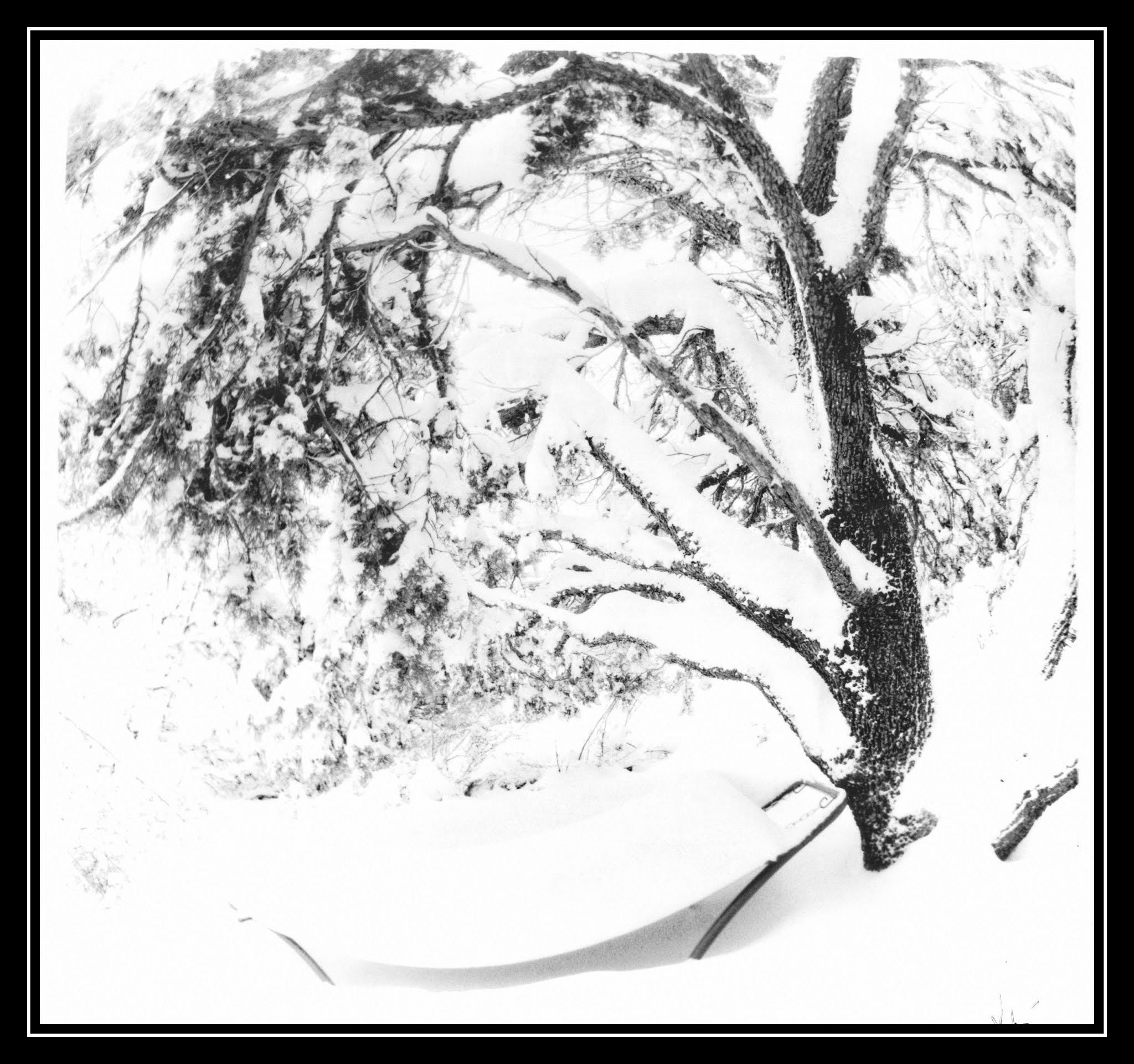
So, in the high mountains of Arizona, between 4,500 feet and 6,500 feet altitude, we had a wonderful snowstorm that dumped more than 2 feet of snow on average. So it was time to use the famous Ukrainian ARSAT 30mm lens on my Salyut-S made in early 1970s. This lens is fisheye-like as if the edges are cropped it behaves like a ultra wide angle lens for medium format photography.

I have two wonderfully working Salyut –S and one non-working, patiently sitting on the shelf in case I need a spare part to fix the working ones… Actually I have dozens of such multiple classic cameras in 35mm and medium format that I have collected over the past 5 decades. And since it is practically impossible to find a repair person for these “antiques” I have learned the tricks of camera organ transplant or at least resuscitation!

Here are my two cameras. The ARSAT 30mm wide angle lens weighs about one kilogram, and the 150mm Kaleinar – 3B is not far behind. The 90mm Vega – 12B is a delight to use and its uncoated lens always “interprets” what I see in slightly different way…


Here is a side view


And a top panorama of the waist level viewfinders.


I will not write much about this handmade  camera (1957 to 1982)and lenses but for those interested here is a good discussion on the Net:

https://emulsive.org/reviews/camera-reviews/kiev-film-camera-reviews/the-mighty-salyut-s-or-how-i-learned-to-love-a-hasselbladski


So, there is a 300+ year old Alligator Juniper tree in my backyard. It is native of northern Mexico and its name reflects the texture of its bark that is like alligator skin. The tree is about 20 feet tall but its branches cover more than 20 feet in a perfect circle. Even in the heat of the desert summer it is enjoyable to sit under it and benefit from the aromatherapy its oily juniper leaves provide.

I have a small hammock under that tree for reading or to reminisce.

The heavy snow had bent all the branches and the snow almost covered the stand legs of the hammock. Perfect setup for a wide angle photo which is shown at the outset of this essay.

It was a clouds moment when I went under the tree and took a contre-jour shot with a 100 ASA film, lens open wide to its maximum of 3.5, and a speed of 1/125 second. I wanted that dreamy effect with the snow reflecting light all around the tree.

I did not crop when printing it with my 1950s HANSA Pro enlarger. The bending of the branches  are a bit exaggerated because of that.

But this lens can also behave like a fisheye lens if shots are taken by pointing the lens upward. Here is a photo I took in Vienna of a street mime with the famous Stefansdom Cathedral as background.


On the same day I took a photo of schoolchildren surrounding a mime. In this instance I cropped while printing for a super wide view.


…  There is something very relaxing when using a 50 year old Soviet medium format camera that weighs 5+ pounds with a special lens…


January 29, 2021

© Vahé A. Kazandjian, 2021

Saturday, December 5, 2020

Epiphany in Photography -- the Role of Apophenia and Pareidolia


A psychologist friend of mine sent me an email with an attachment. “It is a Rorschach ink blot,” she wrote. “Tell me what you see. I want to see if your personality has been affected by the pandemic.”

Well, I saw a horse, a naked woman on a horse just like Maureen O’Hara in Lady Godiva. Or Heddy Lamarr. Or Bo Derek.  In some instances the horse was black. In others it was a pinto.

“Ok, I see you personality has not changed – good. Now tell me if as a photographer you have experienced pareidolia in framing your pictures. I know you probably have experienced it as a poet, but tell me about the photographer.”

Epophenia and pareidolia – somehow related to schizophrenia in seeing connections between unrelated things. But pareidolia where a person sees hidden messages in a cloud or a group of people in the street is probably not that uncommon for photographers. Sure, both have serious psychiatric meanings, but any artist who tries to see a connection between shapes and meanings somehow gets “diagnosed” as one way or another!

… But her question did trigger an interest in me that I could explore looking through scanned photos.

So I did.

First, I recalled a photo that I had not published before which I took during a mountain hike. I recall I had my Pentax 1000 with me loaded with a Croatian Efke ASA 25 film. I usually like this combination when I am hiking since the camera is a very basic model and I am pretty sure that it will not stop working when I need it. The ASA 25 is a perfect speed film for detail when playing with light and shades.

Anyhow, this photo, the one at the top of this entry, immediately captured an angle where the rock seemed like a face “speaking” to the mountain ahead of it. The trees were perfect for frame and detail.

Here is the cropped section of that negative – see the face?


Second, clearly there are structures that remind us of common things. For example look at an ironing board that was in the hallway of a motel in Cape Town, South Africa. I do not consider such resemblances appreciated through pareidolia.


Third, there are unpurposeful and unarranged arrangements that have an inherent anthropomorphic identity. See the two chairs in a conference room. Again, to recognize their resemblance to two people conversing has nothing to do with schizophrenia!


Fourth, and given my childhood around the Mediterranean Sea, for me the most plausible and culturally celebrated association between epophenia and pareidolia is reading the coffee grinds in a demitasse. Indeed, finding patterns and messages and interpreting them as a forecast, a warning or a blessing from above is as old as any human culture. Perhaps the oldest is interpreting cloud shapes. Or reading animal entrails. Or reading tea leaves. Or coffee grinds. No matter, I lovingly remember all the times when after dinner coffee was served and a designated person was given the demitasses after the coffee was drank. Then started the delightful ceremony of seeing faces, shapes, roads, presents, and anything in between.  A true art these grind readers had for imagination!

Well, not around the Mediterranean anymore but my old habits do die hard. Or never. So I still make my own boiled coffee and read my own demitasse!

Here is the coffee pot:


It is a cherished cultural moment especially when I use the handmade copper Armenian coffee pot with a wood handle my mother used. This one is from the Soviet days, adding a bit more history to the process.


And the coffee grinds. How can one not see the man and woman who will in 4 or 40 days come to visit me? I can even see a face mask since I am sure they are very careful about safety during a pandemic!


.. So, I shared the draft of this post with my psychologist friend for reaction. She wrote:

“This is like a symphony where you used different dimensions as instruments to make your point. But I still think that the poet and photographer work best as a team. More like a sinfonietta.”

And she followed it with another email:

“Ha! I am surprised you did not see the naked woman riding a white horse in your demitasse!!!!”

December 5, 2020

© Vahé A. Kazandjian, 2020


PS/ Le Moment Decisif

There is not a single photographer (I have to assume) who has not heard about and experienced the famous description of timing proposed by Henri Cartier-Bresson. The decisive moment is the intimate partnership between a camera, a photographer and the evanescent moment to be captured on film (or via pixels).

What I am about to say may be controversial or at least uncommonly encountered – I believe that the photographer has to be given credit not only for anticipating the moment and clicking at the decisive moment, but for doing so though the recognition of patterns in that environment that would come together only at the decisive moment.

In other words, a great photograph has the essential context of pareidolic existentialism (my coining of terms.)

Ok, I know many will find this statement “unusual” but in my 50 years of street and portraiture photography I have often experienced the making of a “message” in the environment that said “be ready when X and Y synthesize with Z. That is when you click.”

I will leave the readers decide…

Saturday, November 28, 2020

Wine and the 2020 Pandemic


I was walking my dog on a back street where a number of bars have their second entry door. I saw the sign about wine and wanted to take a picture. At that very moment a woman came by and asked if she could pet my dog.

It is a totally unscripted shot but one that may say a lot about how people are coping with isolation.


November 11, 2020

© Vahé A. Kazandjian, 2020 


Saturday, October 31, 2020

En Plein Air Painting -- The Impression Impressionists Have Left


I have the frequent need to dig out old cameras from my collection and see how we still, together, can capture a moment.

In the past weeks I have been playing with a late 1940s Praktica FX3 that I have had for many decades. It is a sweet camera if you have time to frame, focus, and figure out why the pictures go from left to right in the e waist level view finder…  Yes, it is a 35mm waist level viewfinder camera with some serious sophistication. One of them is that it takes M42 mount lenses and has an internal, albeit obscure, switch to actually use semi-automatic lenses from the 1950s and 1960. So, instead of the cumbersome pre-set lenses, I like to use Honeywell Pentax lenses that are truly magnificent.

So, here is my FX3 with a 135mm on it and a 50mm Pentax Takumar lenses:


As a collector and a user, cameras with a historic background have a special meaning. This Praktica was made in Germany during WWII when Germany was under Soviet invasion. Here is the encryption:


I have been keeping this camera and lenses in my car in case I see something worth of street photography. Indeed, a few days ago I was parked my car in a state park to walk my dog and saw painters practicing the lovely tradition that impressionists like Monet made so popular – the joy of taking your easel out to the field and capturing landscapes.

So, the first picture I took is at the outset of this page. The film is ASA 100 so I do have some latitude with the lagging speeds of the camera:

Then I saw another painter perhaps 100 meters away. Here is the capture with the 50 mm f1.8 Takumar:


Of course I had plenty time to shift to the 135 mm lens for the following shot:


When I developed and printed these shots, I could not resist thinking about the Impressionists’ influence on framing this shot. Sure, it is amateurish, and it is influenced by the digital scanning of a film-based print, but still it does have that feel of the “plein air” painting that many artists dream to have the time to practice.

Here is the digitally ultra enlarged crop showing the painter and easel:


So, a 65 year old camera and Impressionistic themes – what can be better when the original goal was to take a 100 pound Akita for a walk on Halloween eve!


October 31, 2020

© Vahé A. Kazandjian, 2020


PS/ I got an email from a viewer who asked how the 35mm waist level viewfinder compares to the medium format viewfinders. It is a great question since given the size of the negative, medium format camera waist level viewfinders are larger, hence easier to frame and focus. 

But the 35mm ones can be very bright and with some practice as easy to use as their medium format counterparts.

Here is a comparison between my Praktica FX3 and the venerable 1948 Rolleiflex Twin Lens Reflex camera.


And their viewfinders


Sure, the 35mm has a smaller viewfinder  but I like the brightness of it.

Saturday, October 17, 2020

A Look at Today Through Vintage Soviet Lens and Camera


A fine gentleman, after visiting my photography blog decided to donate his 1954 Zeiss Ikon Contaflex to my collection of vintage mechanical cameras. He was surprised and happy to find someone who still uses film, and I promised to take photos soon since he had not used it for decades,

As I was making room for the new camera on my selves, I came across a 1950s Soviet FED lens in Leica 39 mount. It is called Industar and a humble lens in performance and it was attached to a delightful FED-2 camera I bought many, many moons ago. I had never used the lens knowing its limitations, but decided to give it a chance after all these years sitting in the back row to lenses that have made my love of B&W photography so intimate.

So, I put the FED 26M on the FED-2 camera, loaded 10 frames of film (yes, I still load my canisters so I can decide on how many frames to load depending on the purpose) and took it with me for my dog’s morning walk at a nearby lake.

Here is the camera and the lens I had never used. Both are Soviet made in the early 1950s.


Of course using a 65 years old Soviet rangefinder camera while having a 95 pound Akita pulling you on the trail is a formidable task! But I managed to take one shot in contre-jour when he jumped atop a 10 meter boulder and pulled his tongue at me! I just wanted to see how the lens behaves in various light situations.


Well, it did poorly, of course. But it does have that feel only vintage glass can give. Technically deplorable, but full of that character folks like me pursue through the use of old lenses and mechanical cameras.

Then, as he was rushing to the lake for a drink, I tried to stop him long enough to focus and shoot one other frame. It is the one at the outset of this posting. The couple provided much character in their posture. The woman was using binoculars for birdwatching, and he seemed patiently waiting for her explanations about ducks and geese…

I like this vintage-feel photo. The corners are soft, the contrast is minimal, and the sharpness is non-existent, but somehow the composition benefited from this old Soviet lens the design of which is a variant of the 1930s German Tessar lens configuration.

…Then, my dog walked into the lake the shores of which are deep and black mud given the lack of rain this summer. When I pulled him back, his legs were already halfway black and he looked like a different dog. I tried to take a quick shot. When I developed the film, I could see under the loupe how uneven the focusing was – his eyes were in focus but his back and tail were not! That is a major flaw of the lens of course, but if used with that limitation in mind, could produce some creative photos…

Anyhow, here is that shot:


Needless to say I returned the Industar to the end of the shelf and made space for the Contaflex.


October 11, 2020

© Vahé A. Kazandjian, 2020