Sunday, February 12, 2023

The Joys of Pareidolia in Photography


A few years go I posted a discussion about Apophenia and Pareidolia in photography https://liveingray.blogspot.com/2020/12/epiphany-in-photography-role-of.html . These are terms used in psychology/psychiatry to describe the seeing of a meaning in forms (clouds, etc) when they really do not exist. In fact, both of these diagnoses fall  within the larger umbrella of schizophrenia.

However, every photographer sometimes sees things that from the right angle, can remind us of known shapes. The light, the shade and the angle of view transform a banal object onto what the photographer applies the creativity of imagination.

So, a reader sent me an email about the above posting saying “…when a photographer sees a form and captures it, should he expect that the viewers recognize it too?”

Well, in some way one can ask the same question about abstract painting or sculpture. Clearly, what the artist presents awakes certain feelings and imagination in those who appreciate and support such creative work.

… I have one photo I took in the Taroko  National Park, Eastern Taiwan that is among my favorites to illustrate the point. The Park is majestic for hikes, and there are waterfalls feeding the Liwu River that carves the park. From the top the gorge I took a few photos of the falls with a medium format Mamiya 645. During one shot, as I was focusing and looking down the viewfinder, I focused on the rock to blur the falls on the other side of the gorge. And in my viewfinder I saw a phantasmagoric creature looking back at me! It had a salamander like body, a large bump in the parietal bone of the cranium, and was holding a small branch under its….

I took the photo, but did not mention what I saw to my colleagues, who were all medical doctors as we were on a trip to evaluate tuberculosis trends in Eastern Taiwan. I knew what their diagnosis of my moment would be…

When I printed the frame, I was even more worried of my excessive imagination, since the creature seemed to be held by a human! I could discern a human face (nose touching the parietal bump, eye half closed, forehead...) seen from the left side, atop the face of the creature. It looks like he is holding "it" on his left shoulder, and there is almost the right arm of the creature that is hugging the person's left shoulder.

So, here is that photo, atop of this page, I publish for the first time. And for those who just see a rock, here is the cutout.


And here is the human-creature hugging


I leave it to the readers to decide.


February 12, 2023

© Vahé A. Kazandjian, 2023

Tuesday, January 3, 2023

Prescott, AZ First Snow of 2023 Through a 1950s Soviet FED-2 Camera and Czech ARISTA Ultra B&W Film


The new year started with frigid temperatures and snow in the High Desert of Arizona. It makes for lovely walks with my dog that seems to slowly go through the 9 months of sunshine and warmth to get his energy burst in winter.


It was snowing gently this morning so I decided to take a camera with me to experience the Prescott downtown before sunrise, and without others yet walking their dogs out.


I did not want the snow to damage my more cherished vintage cameras, so opted for a 1950s Soviet Fed 2 rangefinder which can take “harsh weather.”  I have used this camera quite often, so I made a shade for the Industar-10 lens to minimize flare. Today it would be also helpful to keep the front lens dry from the snow.


I also wanted to test a new 35mm film I recently bought.  Since I roll my films myself, the 33 meter rolls are perfect for deciding if I wanted to roll 5 frames or 15 frames. From a photojournalistic point of view, these are the best number of frames to have while telling a story – 26 frames are a waste of film!

The new film is made in the Czech Republic and uses an old 1950s formula regarding the content of silver on the surface of the pellicule. As such the photos do come out with a touch of nostalgia.


I asked my dog to stop when I saw the right angle of view and depth of field to capture two of the downtown statues. To my surprise he did obey giving me a few seconds to take my gloves off, focus, press the shutter, rewind, change the aperture to 5.6 and take a second shot.

I had, hopefully, 3 more frames left…


I came closer to take one more shot. At this point two ravens came down the trees and teased my dog by walking toward him in the snow.


That was the end of my photo session for this morning!


Of course I could have experimented more with shutter speeds and lens aperture, but for almost the “point and shoot” method I was able to use, I do like the feel of this Czech –made 35mm film.

And I have to admit that I am always amazed that a 70 year old Soviet camera and lens can still do what they were designed to do – street photography.


January 3, 2023

© Vahé A. Kazandjian, 2023

Tuesday, December 27, 2022

New Year Traditions: Pouring Melted Lead, Talking to Farm Animals, or, Dropping a Giant Cowboy Boot At Midnight?


Early this morning I was walking with my dog downtown Prescott, AZ, when I saw the tall crane hauling up the famous Prescott cowboy boot. In 3 days that giant boot would be dropped at midnight to signal the end of 2022 and the start of 2023.


… When a good (or bad) time period nears its end, it seems like “turning a page” or “letting it go out” is the basic human reaction to that end. The wishes and hopes for what is coming next are always for the better, even if that time period was a good one.


But when it comes to cultures celebrating the completion of one calendar year and the arrival of a new one on New Year’s Eve, there are rather surprising ceremonies around the globe.


Of course, dropping a huge ball on Times Square of New York City at midnight on New Year’s Eve has become popular given the anticipation and advertising. But my favorite ceremonials are those from Germany and Romania, just because they do not fit into that “turning the page” anticipated behavior.


“Hope that a heat shapes up” my friend said years ago when I was in Germany “that means love for next year.”


Of course that sounds a sweet wish, but the context is important – in Germany, it is customary to pour melted lead into a bucket of icy cold water and whatever shape is formed in the water is interpreted as a symbol of what to expect the next year. Called bleigiessen, this lead pouring is among the most unusual New Year’s Eve ceremonies I know. Although, it reminds me of haruspicy in ancient Rome, when the haruspex read the entrails, especially the livers of sacrificed sheep and poultry, to learn about the future.


But wait; forget the hugging–kissing-whiskey routine: how about starting the new year in a farm talking with donkeys and sheep as they do in Romania? Even more unexpected, some Romanian farmers believe that their animals acquire the power of speech on New Year’s Eve, and hence they spend the evening waiting to hear what a sheep, a donkey or a horse have to say about the affairs of the world.


… So, dropping a cowboy boot from the tallest building in the cowboy town of Prescott seems quite predictable and appropriate compared to what folks do around the world.


My only wish is that one of those years some engineer would figure out how to make the boot kick as it is coming down at midnight: what can be more of a universal gesture than to kick what we do not want anymore out with a cowboy boot!


December 27, 2022

© Vahé A. Kazandjian, 2022


PS/ And, my early morning walk with my dog on January 1, 2023 was a cold, rainy and foggy one. The boot had dropped last night as the number "2023" is seen on the right of the photo.

Now it was resting back atop the building, in the fog.


Sunday, October 23, 2022

Photography is Not for the Satisfaction of Others. Neither is it Some Kind of Responsibility or Mission. It is a Means to Fill a Personal Void. —Chang Chao-Tang


When I started my photography blog, it was because I needed a structure to organize 50 years of B&W photography into an exploration. The main challenge was to go through countless photos and miles of developed film to chose and write about a few that I had taken across four continents.

After more than a decade and with the feedback of more than forty thousand readers of this blog, my street photos and photography found an identity that I alone knew about once. Now, I get email from readers in more than 60 countries that sometimes trigger a thought I had let go untended.

One such recent email was about a photo I had taken in Taipei more than a decade ago and the reader found it on the internet. Then a search got him/her to my blog and my email address.

The text read:

“Hello, the photo you took of young women in Taipei seems outside the Museum of the Arts. The background looks surreal and there is a story there that becomes a new story everytime I look at it. Reminds me of Taiwan’s best known photographer’s Chang Chao-Tang’s style.”

I traveled, taught and worked in Taiwan for more than a decade starting in the mid-1990s. Indeed, Chang Chao-Tang introduced a new style of street photography to Taiwan through his surrealistic compositions. And he introduced, in his own way, Taiwan to the worldwide audience of the arts. I have seen many of his works, mostly using medium format film. All his works have an à priori choreography through which the artist shares his thoughts. As such it is distinct from street photography where the artist captures the “critical moment” as it happens. Based on that simple dichotomy, I have to say that my favorite remains the photo of a water buffalo working in the field with a man leading it, impeccably dressed in a western suite and fedora hat! The contrast brings a number of sociological themes to the composition as the imagery of a water buffalo in agriculture is commonly found in the philosophy and arts of many Asian countries.


… So, I went back to my scanned files to find more photos I had taken in Taiwan focusing on women.

Let me start with the photo at the outset. In 2007 and 2008 I was involved in research on pulmonary tuberculosis among the aboriginal populations of Taiwan. The east side of the island has majestic forests and wild left topography compared to the west side where urban life is found. So, the aboriginal societies are on the east side of Taiwan and given their close quarters living style, tuberculosis is endemic in that region.

I took this photo of a young aborigine woman during an evening reception at one of the tribal groups. I wanted to show how different the original inhabitants of Taiwan (then called Formosa) look compared to the general population of the island.


And, here is a photo I took on the street of Taipei two decades ago to show how the young generation in Taipei had adopted a life-attitude similar to Singapore and Hong Kong.


Yet, the traditions, symbolism and spiritual dimensions were at every corner of the streets, in every classroom, and in every hospital. Here is one of my favorite street photographs in Taipei where a young woman was making an offering to a temple. I was later told that usually it is a prayer and offering for a good marriage and fertility. For me it was a moment where traditions and beliefs remain part of a culture. 


I enjoyed taking photos inside temples, perhaps because both my olfaction and visual senses were surrounded at the same time by the burning of candles and incense, as well as the chiaroscuro of the rooms. I found such photography more than capturing moments on film – rather, it was the moment that captured me first. 


As an academic and visiting scholar to a number of universities, I cannot resist seeing a parallel between a temple and a university. In fact, the first Taiwanese Confucian temple is found in the southern Taiwanese city of Tainan, which was once the capital city of the island. The temple is called Quan Tai Shou Xue, and is historically considered the first real “school” in Taiwan where Confucian philosophical values and folk traditions are kept alive and transmitted to every new generation.

I have visited the Tainan Confucian Temple more than once and, of the endless sayings by the great teacher, I have consistently used one quote in my professional life that I saw in the Temple:

                                                    “Anyone can be taught”

So, here is a photo I took in the open area of the Taiwan National University where a statue of Confucius can be found. This woman was probably taking a break from a walk. Or she was meditating. Or was pensive regarding one of the teacher’s sayings. No matter, I find her posture most germane to a university setting.


During a visit to Taichung City in central Taiwan, I learned about the traditional art of making bone china. In fact, when I showed my appreciation for the porcelain cup in which green tea was served at the hospital I was visiting, I was told it was not porcelain but bone china. And when they realized I did not know the difference, they arranged for a visit to an artisanal shop with the best reputation for making bone china tableware. Indeed, after a while I realized that by adding bone ash to porcelain, the product (bone china) acquires a hue other than white, can be made much more thin and delicate, and lighter than porcelain.

I took this photo in the workshop of that artisanal shop, where the artist was surrounded with bone ash dust and had only a nuisance mask for protection.


Finally, here is the photo about which I received the email that triggered my search of photos I had taken in Taiwan. Indeed, I remember using a Mamiya 645 medium format camera that day with the fabulous f1.9 lens. I probably set the lens to its full aperture with a shutter speed of 1/1000 sec during a sunny day. Hence some of the strange blurring of the background the commentator described as “surreal”.

No matter, it is a lively photo with the body language of the young ladies perhaps in response to the man behind the magnificent stone statue.


… There are more photos along the theme of this essay, but I will stop here and go back to the opening quote from Chang Chao-Tang.

Is photography a means to fill a personal void?  Does poetry fill yet another type of void? Or eventually all artistic expressions are primarily a personal exploration of the artist’s very own self?

I think they are. But the critical characteristic of that exploration is not the filling of a personal void, but sharing the filled void (no matter how much filled) with others.

We can all be taught, as Confucius said. We just have to find the right time and tone in sharing what we have learned. Then the void we had filled becomes a space for others to visit and perhaps find their own voids to fill.


October 23, 2022

© Vahé A. Kazandjian, 2022


PS/ These and many more photos can be seen on my blog by searching the blog under “Taiwan”

Monday, September 26, 2022

2022 Highland Games and Celtic Faire, Prescott, Arizona


Prescott, Arizona is among many cities in the U.S where the tradition of annual Highland Games continues. It is reported that the first U.S and longest running Scottish Highland games took place in San Francisco in 1839. While the exact origin of these games is not fully known, there are references such games during the reign of King Malcolm III (1057-1093). Today, Highland Games are celebrated around the world.


I enjoy “street photography” during cultural, open air events because they provide the opportunity to capture moments of groups one would not see on regular streets. But, I do not attempt to use my old mechanical film cameras to capture sporting events – today’s digital cameras can capture at least 50 frames of movement while I am focusing and rewinding. Instead I try to identify the spirit of such events.


I have posted photos of previews Highland Games as well as Native American celebrations1,2,3,4 In all instances I have pointed a 1950s Leica rangefinder, 1960s medium format cameras or a Nikon F to people hoping to represent the mood of the celebration.


Yesterday, September 24th, was the first day of the 2022 Highland Games in Prescott and I planned to continue my own tradition of taking street photographs of that first post-Covid Scottish and Celtic event.


… In the past few months I undertook the tedious task of fixing some of my cameras that had been sitting on the shelves awaiting the day when they can click again! The timing was dictated by the longer than usual rainy season we had in Arizona keeping me away from the outdoors.

One of the cameras to be fixed was an early Olympus OM-1 from the 1980s.I expected this to be an easy job as the camera seemed to work fine (shutter, speeds, rewind, clear viewfinder) except the light meter which seemed to have given up on the await for going out to the streets with me again!


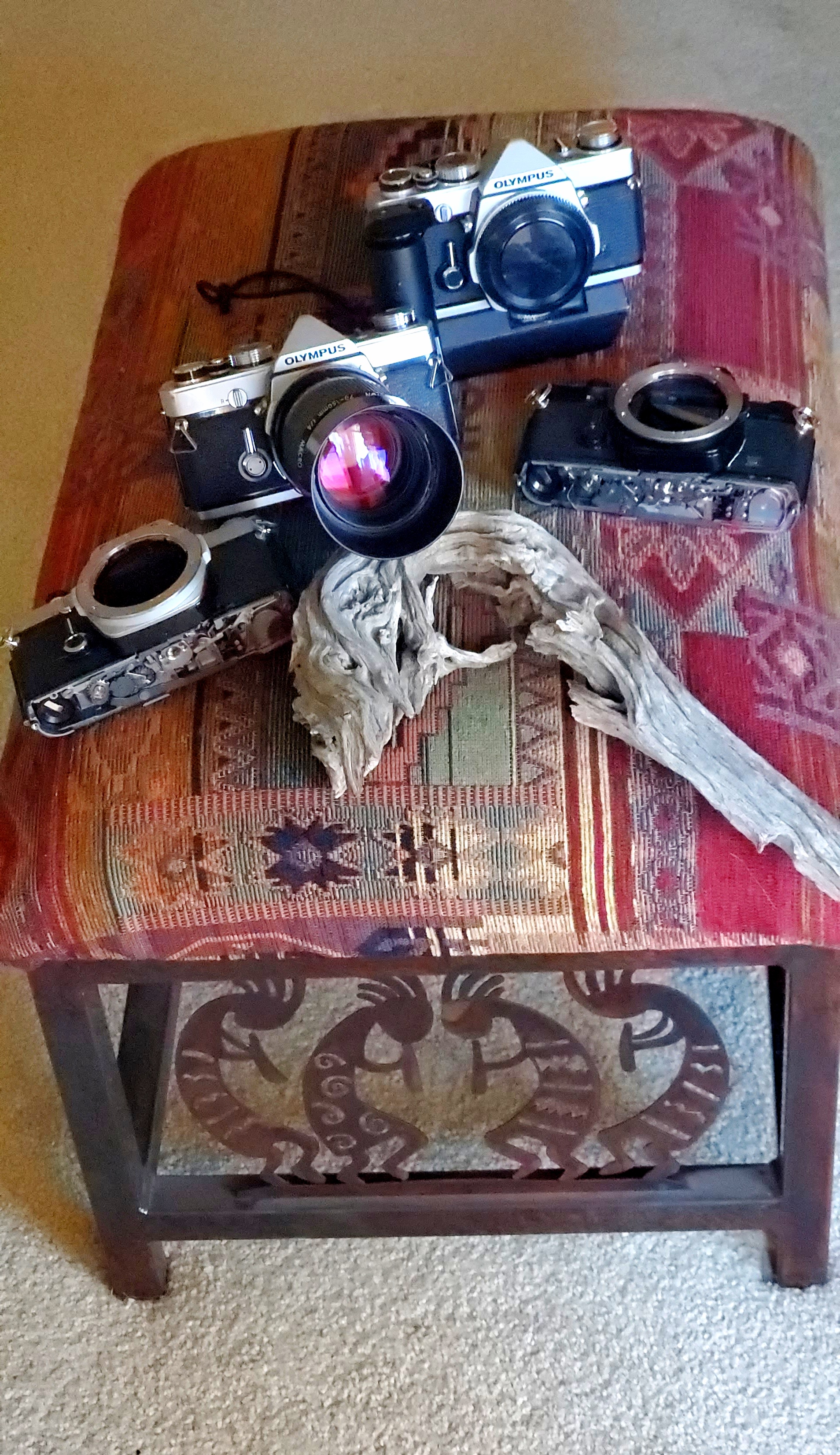
First, a short background. When digital cameras started to be the craze as and film makers announced that they will not make film anymore, the camera market got flooded with great classic mechanical cameras people were trying to get rid of. I already had my collection of useable mechanical cameras spanning from 1938 Leica rangefinders to the 1969 Nikon F. But the abundance of very affordable cameras in the 1990s allowed me to buy one, two or even three of the cameras I had as spares or for spare parts as I knew there will soon be no one to repair these old cameras,

So, I have three OM-1 cameras: two of them were broken and got them for practically nothing. The third one had a non functional film winding lever, so it came with a speed winder that made the camera functional. The fourth was my original OM-1 that worked perfectly for decades till the light meter gave up.

Here are my cameras:


Ok, I was ready to dismantle the otherwise working camera and see if I can get the electric circuit tested. But first a simple removal of the bottom plate identified corrosion on the red wire where someone had already repaired before. A quick cut-and-rewiring fixed the problem!

It was indeed a very simple job.

Next, I had a Kiron 70-150 F4 zoom lens that one of the broken camera sellers had thrown in to sweeten the deal. I am a prime lens user and had never tried this 1980s zoom lens, although Kiron had a great line of lenses decades ago.

It was time to try the light meter and this zoom at the Highland Games.


Every one with the wonder digital cameras was endlessly clicking when competing athletes were throwing the 6 meters tall wooden beam or caber. I wanted to test the zoom lens on the attendees as a street photographer.


My first shot at 70 mm focal setting. It was the perfect sun and shade combination. The repaired light meter suggested an aperture of 11 at 1/125th second shutter speed. I liked the printed photo as it has a nostalgic feel to it regarding B&W photography, and captures the Scottish identity of the games. So, it became the opening photo of this posting.


Next, I walked to the area where pipe players were practicing before marching as a band. That area was behind children’s playground and one pipe player stood perfectly in between the playground pipes as if a framed picture, One click, and he had moved. I was eager to see how I captured that moment when negative would be developed in my darkroom. This time I used the 150mm focal setting on the zoom.


Then I followed the sound of the pipes to see three pipers rehearsing . I patiently followed their random walking patterns to compose a couple of shots.


I was delighted to have explored that practice area as three pipe players, walking around gave me the composition I like most – unplanned movements that end up in a visual story.  These were also taken at the 150mm setting


Finally, I thought I should at least take one photo of the beam throwers. Unfortunately the 1/125th shutter speed was too slow for the quick action, but when I looked at the developed negative the flying beam looked out of focus in an interesting way. So, after a couple printing trials under my 1950s Hansa Pro enlarger to which I had fitted a Soviet Industar-22 rangefinder lens, I was pleased with the surprise – the caber looked like a giant cigarette! Or a UFO of sorts...


There you have at – a roll of B&W 35mm film with a 1980s Olympus OM-1 camera sporting a Kiron 70-150mm zoom lens. I was pleased with the lens as it does render that slightly soft but contrasty look of 1980s photos.

And, I am sure all others at the Highland Games took countless pictures of the marching bands and the competing athletes, in colour, with their digital cameras. I hope my B&W photos and mechanical camera captured moments overlooked by others.

1.      https://liveingray.blogspot.com/2016/05/highland-games-prescott-arizona.html

2.      https://liveingray.blogspot.com/2018/09/annual-highland-games-in-prescott-az.html

3.      https://liveingray.blogspot.com/2019/04/inter-tribal-gathering-of-contemporary.html

4.      https://liveingray.blogspot.com/2018/09/inter-tribal-native-american-pow-wow.html


September 26, 2022

© Vahé A. Kazandjian, 2022

Sunday, September 4, 2022

Photos from a Modified 1955 Soviet Zorki Camera Using 20 Years Old Expired AGFA Film


As I posted previously, the rainy season in Arizona gave me the opportunity to stay home and repair old cameras that were sitting on the shelf. One of these cameras is a 1955 Zorki.

I have collected and used most models of 35mm and medium format cameras from the Soviet Union days. It is well known that while most cameras were somehow “copies” or imitations of German and Swedish classics, the Soviet cameras never worked as well. In fact often they never worked. However, many of the lenses paired with these cameras did include innovative modifications of the lenses they copied and some worked beautifully.

I belong to those photographers who knowing all the limitations of these vintage cameras, still pursue the challenge of making them work, for reasons that cannot often be justified if the goal is to have reliable and able instruments. But for historical reasons and for the stubborn belief that somehow, a lens can be mounted on a camera and both modified enough to produce photos most would find irrational to spend so much time trying. After all one can just buy a digital camera or just use the one in any smart phone and get instant pictures. Why still use film, 50 or more years old mechanical cameras, and spend time in a darkroom?

For those of us who for more than 50 years have seen what film and mechanical cameras can produce, the above questions seem unanswerable when asked by those who have come to photography with the digital age.


So, the 1955 Zorki is one of my favorite Soviet rangefinder cameras as it is very well built, is reliable, and is a joy to hold in my palm while walking in the streets. Sure, it is not a Leica, but it has an undeniable character that is very pleasing.

… It was the 1990s when film started “fading away”. Very soon mechanical cameras lost all value and one could buy them for next to nothing. More, sellers would throw into the deal a bunch of lenses, light meters and darkroom tools. After all who needs these if no one would be using film cameras anymore?

In short, I ended up with dozens of lenses with each Soviet camera I bought.

Of course most of the lenses did not work well on the cameras they came with either because of factory defects of having been dismantled by previous users who did not know how to put them back together. And then, the specifications of the camera and lens were often off the tolerance levels, so a good lens would not focus to infinity of a good camera would not allow the lens to go on perfectly.

My Zorki suffers from the latter.

Therefore, I decided to fit a mechanically sound Industar -22 on the Zorki and figure out how I can make it focus correctly at 1 meter and at infinity.

It was slightly off-focus on both of these distances, so shimming could be a solution. But the Industar-22 lens is not easy to shim, so I attempted the unorthodox approach of taking the camera’s lens mount out and try to play with the lens’s rear element to the camera distance.

… I was glad it rained for many days non-stop in Arizona, as I cannot recall how many improvisations I made to adjust that distance.

Somehow, it worked.

So, here is my Zorki. I also improvised a yellow tinted glass cover (using the tube sleeve of a ball pen) on the rangefinder window – now focusing is easier with the increased contrast.


Given the desert sun of Arizona, no camera lens performed well without a hood. So I made a hood out of a metal tube and fived it to the aperture ring. Now it is much easier to change the apertures, the lens will not suffer from flair, and the images are expected to be more contrasty and higher definition.

The hood has a red dot (made with a drop of nail polish) to match the aperture numbers on the lens.


 Now it was time to test if my modifications work! But I needed to increase the suspense by rolling into a canister about 12 frames of B&W film that had expired about 25 years ago… Here is the film can (suggested expiration date shown as 2005) and I think that I still have about 10 meters of pellicule left in there for future experimentation.


Ok, here is the test.

It was high noon and Downtown Prescott had started the festivities for Labor Day.  Before walking around in the crowd, a quick lunch seemed appropriate. As I was looking at the chef prepare sandwiches, I thought the first frame of my test film strip should be the combination of low shutter speed and full lens aperture. I had never used slow speeds on any of my Soviet cameras because I did not trust that they really worked.  All my shots (and I have miles of negatives’ strips to prove) have been either at 1/100 sec of 1/200 sec always with ASA 100 film. This time, I set the shutter speed to 1/25th sec and the lens aperture to 2.5, the widest opening on an Industar-22.

It was quite dark, so I focused on the light fixtures to see how the depth-of-field will work. And as I was about to press down the shutter, a cook peeked out of the window in the cooking room! Probably someone told him "Check this out -- there is a strange man at the front table with an antique camera. And, in our hamburger restaurant, he ordered a grilled Portobello sandwich!"

Ah, the unexpected joys of street photography.


Surprisingly, the photo came out better than I expected (the 1/25th sec shutter works!) and has that vintage feel to it.

And the look of the cook in the window just made the photo!


Next, a street magician provided the opportunity to test the 1/100 sec speed but I had the aperture at f8 which resulted in an under-exposed shot. However with a full 60 seconds of light exposure under my 1950s Hansa Pro enlarger, I got a reasonably good definition photo but with a delightful contrast. The photo at the top of this posting exhibits rather pleasant tonal range transitions of gray and the underexposed frame resulted in a lot of grain with the long exposure under the enlarger.

But the photo of the magician also came close to the concept of Chiaroscuro primarily used in Renaissance paintings -- a mix of light and shade that resulted in a tri-dimentional feeling with the blurry background.


I finally wanted to see how the sharpness of the Industar-22 holds at infinity. The photo below was cropped to emphasize what the lens can do if I had used an aperture of f8 or f11. Instead I used a wider f5.6 which washed away all tonal transitions.


In summary, the shimming worked, although I am not sure why. I have always preferred the coated Industar-22 to the uncoated Leica Elmar, and I will continue to use it.

At the end of this experiment, I felt like I had lived in a time bubble for a day. Expecting a 1955 Zorki to perform like a 1954 Canon L would be akin to taking a 1938 VW beetle to the Paris-Dakar Rally and hoping it would run for a 100 meters in the sand.

But what a joy it once was to drive that VW through the Chitta Vecchia in Bari, Italy!


September 4, 2022

© Vahé A. Kazandjian, 2022


Tuesday, August 30, 2022

Pushing the Electronic Shutter of a 1980's Minolta X-700 to its Limits in Downtown Prescott, AZ


The past month was the rainy season, called monsoon, in Arizona. This year the much needed rain was plentiful, daily and revitalising. The desert turned to a garden of wild flowers and lush green meadows; although many towns and cities suffered damages from flash flooding.

With restricted possibility for outdoor adventures, I decided to tackle a task I have been putting off for a long while – repairing, cleaning and adjusting some of my classic cameras that have been sitting on the shelves without exercise.

First, I took on the adjusting of the shutter second curtain on two 1980s Olympus OM-1 cameras. It is a tedious job but I find it relaxing as I am very patient with detailed work. And, as a break from the detailed work, I played with the electrical system of a non-mechanical 1980s, the Minolta X-700. Indeed, the latter was much easier to fix and wanted to take the Minolta for an outing after having ignored it for 20 years!

Here are the cameras I worked on


The X-700 was a popular camera 40 years ago, primarily because it has an Aperture Priority mode allowing the photographer be creative with the choice of lens apertures without worrying to simultaneously adjust the shutter speed. Of course these functions are now “prehistorical” with digital cameras, but 40 years ago it was the dream of every amateur photographer to afford such a camera (Nikon F3 had that function but was beyond the price range of many).

The other attraction of the Minolta was the fast 50mm lens. I find the Pentax lenses of that era better built and rendering more pleasing photos, but the Minolta was well received in the field.


… So, rolled about 12 shots 35 B&W film into an old Kodak canister (yes, I still buy 100 meter of bulk film and roll them myself…) and went for a short trip on memory lane.

My goal was to test if the camera still works (meter, Aperture Priority mode, frame spacing, etc) and see how an old “fast” lens (f1.7) renders background blurs in the very bright desert sun. The challenge was worthwhile since the camera has an upper shutter speed of only 1/1000 second which means I would not be able to use the 1.7 aperture in bright light.

But wanted to try.


The photo atop this page is from downtown Prescott. I took it at f4 and let the camera decide on the shutter speed. I focused on the man with the cowboy hat rather on the historic sign to see how the forefront and background are rendered.


Then, I tried using the 1.7 full aperture with scenes where shadows and sun mixed. Here are three compositions:

1.       Sun filtering through tall trees.  This abandoned car (can you see it?) was perfectly camouflaged by the trees, the filtered grades of shade, and tall grass. The lens “interpreted” what I saw through soft edges, blurred background and good sharpness in the center. It gave the moment an almost psychedelic feeling!


2.       Bright reflections in the background. Many of the Prescott retirees collect, maintain and use vintage cars. This one was parked in a semi-shady spot with the sun reflecting on the building behind it –a perfectly natural set-up to test the lens.

It is overexposed since the limited shutter speed of 1/1000th of a second could not handle the amount of light at f1.7. But, it does have some allure from an artistic point of view.


3.       Full sun.  I knew this will be too much for this old camera and its prehistoric electronic shutter at Aperture Priority mode. And it is. But the fun part of the photo is the look the passenger rider gave me when I clicked. Given the folding mirror slap, I did not see her noticing me, and that is what makes street photography delightful.


As expected, the photos will not make the front page of the National Geographic Magazine. But for those like me who enjoy using old cameras as much as getting good photos, it was a pleasure to take the 40 year old Minolta X-700 out of retirement, albeit for a short moment and bring back many memories.

Next, I will find out if my hours of work on one of the 40-year old Olympus OM-1 succeeded in adjusting the travel timing of its second curtain…


August 30, 2022

© Vahé A. Kazandjian, 2022