Sunday, October 23, 2016

Zimbabwe: Where the Wild Things Are

A friend from Denmark sent me the link to a documentary that aired on Danish TV a week or so ago. It is called “Bitter Grapes” and portrays the life of migrant workers in the South African wine industry. Many are from neighboring Zimbabwe, recently in the world news because of the death of Cecil, the black- maned king lion of Hwange National Park.

“You have been to both Zimbabwe and South Africa,” my friend wrote, “what do you think of this documentary?”

I do not know enough about the South African wine industry workings although visiting the various vineyards and tasting wines was a grand experience.

… I wanted to share a few memories from Zimbabwe and South Africa with my friend in my own way, through photos I had taken. The ones I shared with him were not published or posted before, but I now chose them because I took them more for sociological purposes than as a street photographer. Or, perhaps it is not really possible to pursue any street photography without placing them in a sociological context.

A tourist center near Victoria Falls, Zimbabwe. No, it is not Cecil that the world associated with wildlife in Zimbabwe, but elephants. I have come within feet (in an open safari car) to elephants and lions in Africa, and found the big cats much more regal owe-inspiring. Yet the elephant remains the iconic representative of Africa and its wild life.


A note about monkeys. While staying in a safari lodge in Zimbabwe, we were instructed to lock the balcony doors at all times. The reason were the monkeys who have figured how to open unlocked doors and windows, come into a room and take all they can with them. In fact, many of the tall trees around the lodge have hats, backpacks, shirts and shoes hanging from their top branches.
This note not only stresses the point of co-existence with the monkeys but through the added “AND” by a vocal human, the stress between management and workers perhaps…


Social issues. I have seen such postings both in South Africa and Zimbabwe. It is not the type of advertisement one expects to see in Western countries.


Unique artistic expression. This art shop in Zimbabwe was among my favorites. All the artwork was based on the use of ostrich egg shells. It was beautiful and truly graceful. And thinking about ostrich eggs served on many breakfast menus, the use of the egg shells was both a sign of parsimony and creativity.


Bold expression, Cape Town, South Africa. This statue of a handgun with a knotted barrel was among the most vivid social expressions I saw in South Africa. There was a legend to read but one did not have to do so – the message was visually very clear and impactful.


The Africa one discovers, Victoria village, Zimbabwe. The entrance to the restaurant where food was memorable at every visit. Somehow this photo reminds me of epicurean moments.


And this sign, reminds me of my childhood around the Mediterranean, far away from Zimbabwe! Indeed, as a kid, the only shoes I had were made by Bata! Seeing that name there was like being in a time capsule. And then, how delightful it was that one can find many reasons to be at the Wild Thing Action Bar and have fun till you drop!


I keep very warm feelings from travel to that part of Africa.

October 23, 2016
© Vahé A. Kazandjian, 2016

Sunday, October 9, 2016

Palindrome in B&W


I “belong” to a group of artists who found their genre after decades of search in parallel with their professional training and careers seemingly totally different from their present artistic status. Many, like me, are trained in the medical sciences and have pursued their love of the arts in their “free time”. And one day, we all found the context and space to devote our days to the arts.

The Internet keeps us in constant touch, as we live in different states and continents. One of our favorite communication modes is to share our creative works (writings, paintings and photography) for feedback and discussions.

… So, a few days ago I shared a photo I took with a 1950’s Ukrainian 35mm camera to which I have fitted a 1948 non-coated Leica clone lens. I like the surprises in light transmission and sharpness these lenses can produce. It is the photo of a girl in a crowd, looking back, and wearing a faux lion hat.


“Something attractive about the moment” a friend replied. “No sure what it is but it is Gauguinesque. You recall his famous Manau Tupapau”?

“Sure, his Tahitian wife sleeping nude on her belly?”

“Yes, he called it “Spirit of the Dead Watching” as there is a ghostly shape at the end of the bed. There are many interpretations of that painting and comparisons made to Manet’s Olympia and to Borghese Hermaphroditus now in The Louvre. I guess it is the feeling your photo gives of being watched by a ghostly figure.”

“She does stand out in a relatively banal crowd,” I admitted.

“More than that,” he said, “there is the feeling of reciprocity. No, of a palindrome!”

“A palindrome?”

“You know, a word or sentence you can read forward and backward and it reads the same. Like Madam or Dad.”

“I know what a palindrome is. I even remember my favorite palindrome in biochemistry where nucleic acids combine in a special sequence – you remember the inverted repeating sequence AGTTGA?”

“We are done with biochemistry,” he said, “Let’s focus on Gauguin.”

“Ok, so how can a photo like this be a palindrome for you?”

“Well, I see a certain duality here, and my mind goes back and forth between the unknown and unseen faces in the crowd and this ghostly girl. Further, the girl is androgynous in appearance – more as a neutral spirit out of place, but as if she is keeping an eye on the crowd. That is the palindrome for me – you can go from the girl to the crowd, then in reverse, and the feeling is the same.”

“What does this photo tell you?” he then asked.

I thought for a few minutes before typing my reply.

“She has harmony in her smile,” I said. “A bit of a mystery, as if comforting.”

“It is a palindrome in Black and White,” he concluded.

October 9, 2016

© Vahé A. Kazandjian, 2016

Sunday, October 2, 2016

Alzheimer's Walk, Prescott, Arizona

October 1 was the Alzheimer’s Walk in the cowboy town of Prescott, Arizona. A town of retirement at 5,500 feet in the mountains, the support for Alzheimer’s research seems most relevant.
On this morning, I wanted to capture scenes from the march and the town that would be other than photos of the hundreds of marchers on the 3 mile path around town.

Here is a view of Prescott during the march – the flower and the gallery sign represent the type of living here: appreciating the days and all forms of artistic creativity.


The Elk Theatre is one of the oldest and most cherished artistic centers of Prescott. Built in 1904, it features performing arts and opera of remarkably high quality. In fact, on February 10, 1905, Prescott Weekly Courier reported:
"The peer of that theatre is not found east of San Francisco until the great cities of the Mississippi Valley are reached, and even there our theatre is outclassed only as to size, for our theatre is about as perfect as the handiwork of man generally gets to be."


Prescott, niched in the mountain and surrounded by winding roads, is also a favorite stops for bikers, even if they do not participate in all of its ongoing events, this time the Alzheimer’s march.


Talking about artistic centers, one of the town’s museum sign has been delightfully affected by the high desert sun by missing a few letters.


No photo of Prescott would be complete without the inclusion of a raven. These majestic birds are found in the works of many Native American local artists and at times seem to be the true owners of the towns open spaces. This raven, perched upon a container in an alley, watched the marchers pass by and, could not resist vocally supporting their cause!


The march concluded with music and cheers on the Town’s historic square.


Perhaps this photo represents best the feeling of caring and love from that morning. These dogs seem to form a perfect heart.


© Vahé A. Kazandjian, 2016
October 2, 2016


Sunday, September 25, 2016

Beauty in The Arts: Symmetry, Harmony, and Order


I have lived in a number of cultures. I say “cultures” and not countries or societies, as in each of the latter one can find shades of cultural inheritances, indigenous or adopted. My professional and artistic worlds have been influenced by how people perceive disease, harmony and beauty. For me those three sets of perceptions are intricately related in every culture I have found myself.

… I was reading an elegant essay by Crispin Sartwell in the Stanford Encyclopedia of Philosophy which is also on the Web (1). It is titled “Beauty” where the author explores the concept and understanding of beauty through the ages, from Greek, Hellenistic, and medieval philosophers, to reviewing key writings from 18th and 19th century philosophers including Burke, Kant, Hegel, Schopenhauer and Santayana. 

I found myself in familiar territory most of the time. While the appreciation of beauty is subjective, the representation of beauty is collective, hence incorporates attributes that are identified by many. For example, the concept of beauty was different than the one accepted in the Hellenistic period, and both are different from today’s definition of beauty. These differences are easily seen in visual artistic work (sculpture, painting, etc) but also in fashion.

What seems to be a common criterion across periods and cultures, however, is the concept of symmetry. Indeed, beauty seems to require a certain symmetry in form or thought to be recognized as such. Perhaps symmetry is also necessary for harmony (think Newtonian Laws or homeostasis) and eventually a pleasant quality of life and existence. 

A good summary is provided by Sartwell on this topic borrowing from the writings of the Roman architect Vitruvius. It reads: 

The ancient Roman architect Vitruvius gives as good a characterization of the classical conception as any, both in its complexities and, appropriately enough, in its underlying unity:

Architecture consists of Order, which in Greek is called taxis, and arrangement, which the Greeks name diathesis, and of Proportion and Symmetry and Decor and Distribution which in the Greeks is called oeconomia.

Order is the balanced adjustment of the details of the work separately, and as to the whole, the arrangement of the proportion with a view to a symmetrical result.

Proportion implies a graceful semblance: the suitable display of details in their context. This is attained when the details of the work are of a height suitable to their breadth, of a breadth suitable to their length; in a word, when everything has a symmetrical correspondence.

Symmetry also is the appropriate harmony arising out of the details of the work itself: the correspondence of each given detail to the form of the design as a whole. As in the human body, from cubit, foot, palm, inch and other small parts come the symmetric quality of eurhythmy.

I had never heard of Vitruvius, but realized that I somehow belong to the classical school when it comes to defining beauty! That self-discovery made my day.

… So I asked myself “have I unconsciously framed some of my photos to capture symmetry or even harmony?” It was a good weekend project to run through some boxes of printed photos and a few shoeboxes of film negatives…
Here is what I found:

Shakespeare Festival, Maryland. The 1960’s Nikkor-Q 180mm telephoto was wide open to capture movement on ASA 50 film. The two actors were engaged in a fight and the angle I captured emphasizes symmetry.


Madrid, Spain. Early morning in the street. The row of men on public benches reflects a certain order, and the body posture of the first gentleman reading the newspaper a certain serenity. 


Bilbao, Spain. Again, there is order but also a conversation. The posture of the dog adds a dimension of curiosity as to what is going on.


Paris, France. An ordinary gathering of youth around a pond in a park. The moment I saw the young woman being lifted up, I clicked compromising focusing accuracy. There is action, reflection, and again order in this photo.


Manassas, Virginia, USA. I am not sure what the drill was, but it was an introduction to the history of Civil War. The man’s uniform and the boys’ readiness to follow order has order but also the shadow of war and dis-order.


London, England. The mom was paying for a parking ticket, while showing her multi-tasking skills. I think the baby brings in the concept of beauty, along with the symmetry between the ticket machine and mom’s posture. Harmony perhaps?


… It was a fun introspective exercise to identify unconscious photographic compositions I have made over the years. I am sure there is more in the shoe boxes I caringly keep. But I had enough evidence to suggest that, without having knowledge of Vitruvius, my understanding of beauty follows the classic definition of order, symmetry, proportion and harmony.

September 25, 2016
© Vahé A. Kazandjian, 2016


(1) Sartwell, Crispin, "Beauty", The Stanford Encyclopedia of Philosophy (Spring 2014 Edition), Edward N. Zalta (ed.), URL = <http://plato.stanford.edu/archives/spr2014/entries/beauty/>.

The Web site is:


Saturday, September 24, 2016

Ships Dreaming of Seas

Patient, over-patient, is the captain of my ship.
The wind blows, and restless are the sails;
Even the rudder begs direction;
Yet quietly my captain awaits my silence.
And these, my mariners, who have heard the choir of the greater sea, they too have heard me patiently.
Now they shall wait no longer.
I am ready.
                        Gibran “The Prophet”
The sea, the ocean, their waves and the mercurial horizon have found their way to every artist’s heart and imagination. Ships have surrendered themselves to the vastness and mercy of tides and winds. Ports have given respite to these vessels and mariners but the call of the sea has always won.
A ship cannot call a port home.
… For years, my “ship” has been a simple 3 meter long kayak. It has explored seas, the shores of an ocean and numerous lakes. At water-level, I have seen cities look less attractive, trees taller and proud, and the flight of a heron most majestic. I do not solely rely on my memory, tough, as I always carry a camera with me.
That day, I decided to bring a 1938 Soviet FED camera with me into the port of Baltimore. It is a 35mm camera with a lot of history and small enough to fit in the pocket of my vest.  My goal on that afternoon was to come as close as possible to large ships and take photos from a water-level perspective.

Military Ships. These two, seen from below, are awe inspiring. They are like floating villages. The symmetry of how the two ships were anchored was enhanced by my being in a tiny kayak.


What we do not see. A mile away, I found myself in a ship repair area. I had never seen the underside of these large ships. The feeling of a “hanging ship” was a strange feeling – a ship out of water is a sad sight.
Here is my approach to the ship:


And how sad it looked to me…


Shipyard in Cape Town, South Africa. I was not in a kayak that day, yet even looking from above, a hanging ship looked as sad in South Africa as it did in Baltimore!


Happy Ship, Lake Cuomo, Italy. This one, a restaurant and bar upon the blue waters of the lake, gives a very different feeling from the above ones. It is surrounded by the snow capped Italian Alps, and is most inviting.


… … While Gibran’s Prophet knew that his mariners had heard the choir of the seas, I wanted to focus on the ships and "catch" them in various states of their being. And I am sure that neither my quiet approach in a kayak in Baltimore, nor a telephoto lens in South Africa or Italy disturbed their quiet times. 

September 24, 2016
© Vahé A. Kazandjian, 2016


Tuesday, September 13, 2016

The Art of Managing Timing


I have always found the concept of timing a central criterion for evaluating actions we take. As a health care professional, I have applied and promoted the axiom that quality of care is achieved by “doing the right thing, the right way, for the right person, at the right time”. In addition, there is an art in medicine that cannot be separated from the science (no matter how incomplete the latter is.)

As a photographer, the timing of a frame is as important for the quality of the outcome. And, the art in photography is expressed through aesthetics, as the medium of expression is primarily visual.
Eventually, timing is important for all of our acts and actions. Being in the wrong place at the wrong time is a recipe for undesirable outcomes or acts. And, being with the right person, at the right place and right time can only result in memorable consequences.

… Back to photography. A colleague while showing me his recent photos of sunsets stated:
“I waited for hours and days for the right light. I wanted to capture that split second when all became harmony.”

To which I replied:
“Is that an aesthetic goal or a technical one?”

He scratched his head for a second and said:
“I do not know – I leave it to the buyer of my work to decide.”

… I have not pursued technical perfection in my photography. In fact, it is practically impossible to do so as a street photographer who has no luxury to frame, compose and wait for “all to become harmony”. My purpose has always been to be a story teller, as I have in my literary works. Yet, timing remains critical as both of us have to capture that split second scene, albeit while pursuing different goals.
So, I showed him a few of my scanned photos.

Maria Sharapova, US Open, NY, 2011. She is among the most photographed tennis player in the world. With my 1970s film camera and telephoto, it would have been foolish for me to try to take a photo comparable to ones modern day digital magic-boxes can do. My light-box (or dark-box) could only hope to find an unusual yet aesthetically pleasing composition of her. And, she is best known for her moments of “self-composure” when she regroups after critical points.
I tried to capture that iconic composure. The lens was wide open sacrificing detail to isolating her from the background.


Paris, France, 2009. I carried a Mamiya 645 medium format camera that day. Two American tourists, young women full of excitement for being in Paris, were approached by this man who, among other things, wanted to impress them with his athletic prowess. When I saw him jump once, I pointed my lens and clicked during his second jump. I did not crop the picture – his head was indeed not in the frame. And the feet, body posture and bewildered smile of the young women make the shot. For me, the aesthetics of the photo come from the old stones in the background and other passants’ debonair attitudes.


Mumbai, India, 1998. I stayed at a motel on the beach called “Sun & Sand” (yes, still remember the name…). One morning, before starting work, I was having tea while looking at the ocean when this family came by. A few minutes later he was throwing his daughter in the air. I had my Olympus OM-1 with me and took this quick shot. It was only a few minutes later that I understood why he was doing this: he had seen me and he came over asking for money for having “watched the show”…


Inner Harbor, Baltimore, Maryland, 2011. This was the year when “occupy” was the name of the movement. From Wall Street to the bank and cities themselves, there was a social movement in discontent of decision-makers’ perceived behaviors. The streets were filled with demonstrators that day so I took my bicycle to move around with ease. Also took my 1969 Nikon F for the ride. I did not want to take photos of demonstrations or demonstrators. This was the only picture I took.
It is technically very flawed as I had to stop my bicycle, rotate my camera from my back to my face, focus and click. Yet, aesthetically I got the two ladies in the positions I wanted regarding the letters on the banner and the photo tells the story of the times.


… So, technical, aesthetic and story-telling dimensions seem to find their way into the understanding and managing of the concept of timing. Eventually, I believe that the successful synthesis of these dimensions is elegance.

September 13, 2016

© Vahé A. Kazandjian, 2016

Friday, August 26, 2016

Saint Anne de Bellevue, Québec, Canada

On a recent trip to Montréal, Canada had the opportunity to visit a small town away from the city. It was a rainy day and walking around was not an option. Still, Saint Anne de Bellevue had a few moments for my camera to capture from the covered patio of a restaurant.

The boardwalk was deserted given the heavy rain. Yet the two trash bags seemed to get ready to take a seat on the outdoor chairs perfectly positioned to watch boats going by.


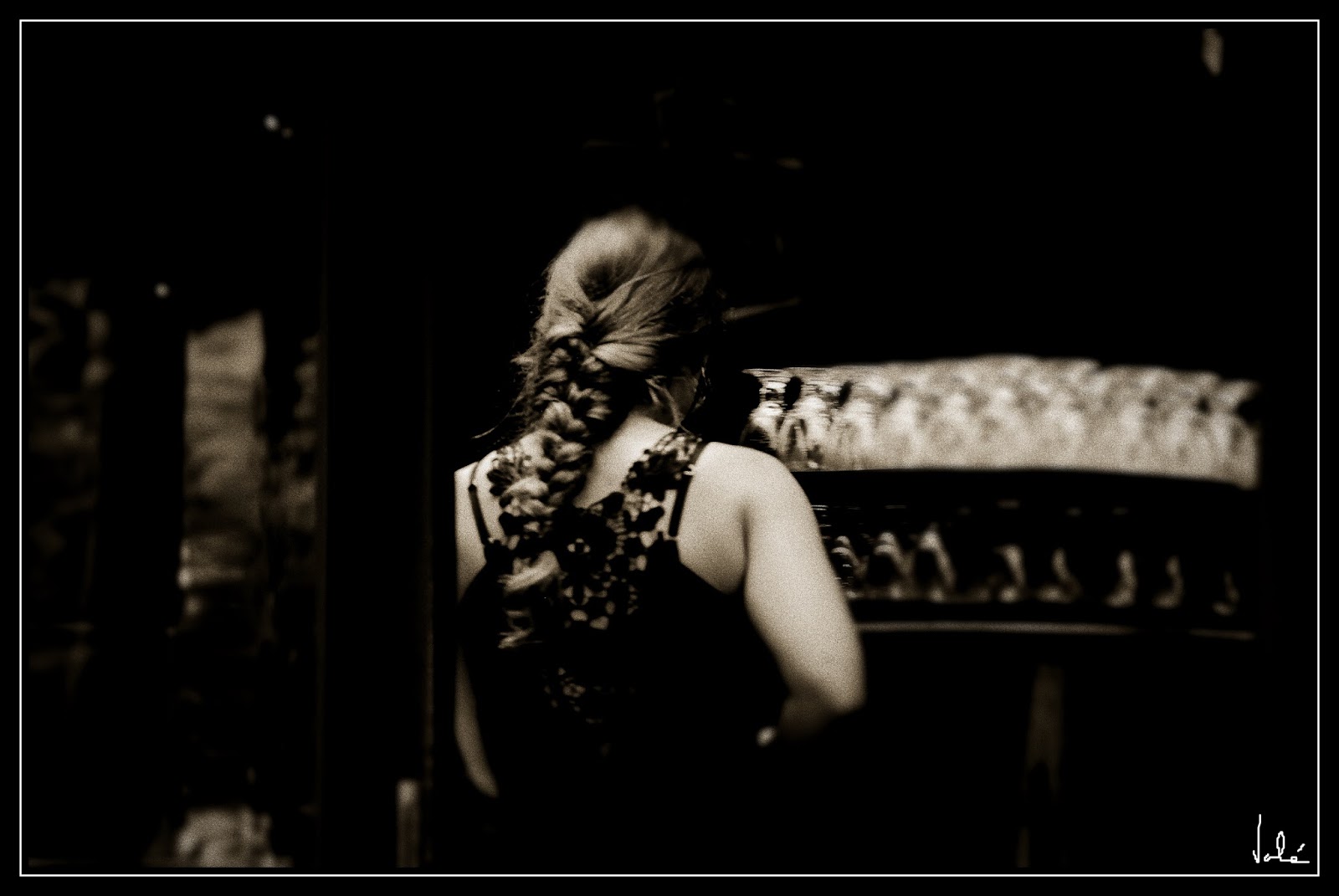
The waitress was pleasant and happy to have customers in the afternoon. And I wanted to capture her braided hair with my 105mm Nikkor lens wide open to 2.5. The result was a perfect tonal range I still find as the central attraction of B&W photography.


This man was the only one walking the boardwalk. His debonair attitude and attire gave a harmony to the incessantly falling rain.


Finally, a moment of respite and the promise of sunshine. A few folks walked the street which was the only main artery in this small town. I noticed this woman with extensive butterfly tattoos on her left arm and wanted to let her blend with the environment before I click. Here is the composed photo.


And to show how well the butterflies blended with the brouhaha of the casual clothing store, here is the enlarged portion. The timing of depressing the camera shutter release was perfectly synchronized with her walking pace.


August 26, 2016
© Vahé A. Kazandjian, 2016