Sunday, July 12, 2015

Mural Paintings in Flagstaff, Arizona and Albuquerque, New Mexico


My street photography is about people, but this time I was interested in mural paintings of people. I think when such paintings are incorporated into the character of a city or neighborhood, it is about the actual people who live there and their identities.

I found two such paintings that covered the entire side of a building. To show their relative sizes, I incorporated references (a street light and a handicap parking sign) for comparison.  Both paintings are in colour but I also think that their 3-dimensional presentation gets depth with the more pronounced tonal transitions a B&W picture can provide.

The woodsman in Flagstaff:


The nebulous human body (human condition?) of Albuquerque:


July 12, 2015
© Vahé A. Kazandjian, 2015

Saturday, July 4, 2015

Street Photography Revisited on the 4th of July


There were thousands of people in the small town making it a perfect environment for some candid photography. Being a Western town, there were a lot of horses and riders. In my previous posting I had shared some pictures from the Rodeo in Prescott, and some of the riders, their horses and the Rodeo clowns were also in the parade.

After a few minutes of looking around, I decided to focus on the theme of “Horses and Riders” but all was very methodically organized and I did not find an unusual or unexpected event to photograph. Instead, decided to focus on shapes and forms of the interaction between horses and humans.

… Well-worn cowboy boots contrast well with horses’ hoofs. So, as a cowboy was taking the saddles off the horses, I hoped to compose a few scenes.


This one seems like a dance..


It often takes patience to compose that one shot that not only fits a theme I have in mind but is affected by variables I cannot control. Such as a sudden shading in part of the scene due to a passing cloud. This picture got affected by the uneven lighting but helped the picture to stress the shape of the woman handling the horses.


Then, a group of ladies, of a certain age, arrived dressed as Rodeo Clowns. This picture was not composed intentionally, but as I looked at the printed image I could not resist smiling: A clown of the World’s Oldest Rodeo seemed to taking her own pulse to make sure all is ok!


Finally, I noticed another photographer who was taking candid pictures but using a large tripod! I was thinking that it was the anti-thesis of street photography techniques to be noticeable, as it becomes interference in the natural flow of human behavior hence makes the end product, the photograph, biased.  As I was revisiting the basic principles of what Henry Cartier-Bresson had made so popular (using a pocket size 1954 Leica IIIF for his most famous pictures), the perfect composition present itself: the photographer , on his knees behind his most noticeable tripod, was taking a picture of a woman who in turn was taking a “selfie” with her phone! The woman was perfectly in line between me and the other photographer allowing me to make the point that street photographers should be stealth and unnoticed.


But who knows? Perhaps his pictures are perfectly framed and not affected by hand movements I often have to keep in mind when I shoot handheld while trying to continuously focus my 50 or 60 year old lenses…

July 4, 2015
© Vahé A. Kazandjian, 2015

Thursday, July 2, 2015

The Oldest Rodeo in the World


The Rodeo, or “Cowboy Tournament” as it was originally called, is said to have started in Prescott, Arizona on July 4th, 1888. Influenced by the Spanish cowboy lifestyle known as Vaquero, the purpose of the 1888 rodeo was to bring all the skills and lifestyle of cowboys into a structured tournament, hence there were prizes for winners. The success of this show made the rodeo most popular in North America. Indeed, in Canada, the Calgary Stampede Rodeo, which started in 1912, today incorporates more competitive programs such as Junior Steer Riding, Ladies Barrel Riding and Bull Riding.  The one in Prescott stays within the original spirit of Bareback Bronco Riding, Saddle Bronco, Steer Wrestling and Tie-Down Roping, to reflect the true working cowboy’s lifestyle on the farm.


So it was very tempting to go to the World’s Oldest Rodeo in Prescott on opening day, June the 29th.
I was looking forward to taking pictures, although the show started after sunset, challenging the functional limits of any photography tool I have. But I was most disappointed when I learned that telephoto lenses were not allowed! Knowing that I could not be in a crowd without a camera hanging from my neck, I took a fixed lens camera just for fun. The pictures that follow have therefore been enlarged to various extents as I took them from at least 50 meters away with an 85mm lens.

… The rodeo grounds are simple and without fanfare. The show started with cowgirls parading around with flags, then national anthem was sang, and a series of galloping demonstrations followed.


The central structure of the arena is historic and this is where the announcers have their booths, and from under which the broncos enter the arena. It was already dark when the show started.


My favorite was the riding of the broncos. These beautiful horses did everything to throw the rider off their backs and some did so more spectacularly than others.


When the rider was down, some of the horses seemed to celebrate their achievement by continuing their bucking.  I learned that these horses have a “flank strap” put on which causes discomfort and encourages them to kick out. When the rider is down, other riders reach out to the bronco and take the strap out. At that point the horse calms down and in a 180 degree volte-face, walks to the gates under the main structure in a nonchalant way!


Sometimes, when the steer wrestler misses the lassoing and falls from his horse, the steer does the same thing as the previously bucking bronco. This steer came closer to the stands and gave me that look that says “See, sometimes the steer wins!” The light shining in his eyes makes him especially memorable.


When a cowboy falls, his peers make sure that he is ok. This is a competition but not at any cost. The camaraderie among cowboys is most charming to see.


… Summer rainstorms and thunder arrived at the end of the rodeo show. I was pleased that this was not a hi-tech event with huge screens, fancy singers or dancers. It was what I was hoping for: a historical event that is kept as close as possible to its original raison d’être.

In the car, as the rain was forcing all drivers to go slow in the streets that are very dimly lit, I kept on thinking about the symbolism of a lasso. Eventually we capture ideas, hopes and even others with both visible and invisible lassos. Perhaps the lasso of idealism is the most far-reaching and the skill of the user most demanding.

And then, I remembered a photo I had taken a few days before. The posture of this young woman using a hula hoop was so similar to the cowboys and their lasso! I secretly smiled thinking that perhaps the young lady was more skillful with her lassoing techniques than some of the cowboys!


July 2, 2015
© Vahé A. Kazandjian, 2015


Sunday, June 28, 2015

The Decisive Moment: a Daily Reality


I was looking at Stefan Zweig’s “Decisive Moments in History” book (original in1927, English translation by Ariadne Press, 2007) and as a street photographer, was intrigued by the use of the term “Decisive Moment” often attributed to Henry Cartier-Bresson. So I did a quick search and found that there were numerous books, some written before the Bresson era, where those terms were used. For example there is “The Decisive Moment” by Arthur Maxwell (1940, Pacific Press, original in Czech), “Turning Points: Decisive Moments in the History of Christianity” by Mark A. Noll (Baker Pub Group, 1997), and “Decisive Moments in the History of Islam” (2001, Goodword Books) among others. 

Henry Cartier-Bresson would have not been surprised by the widely universal concept of the “decisive moment” since he has stated that “there is nothing in this world that does not have a decisive moment”. As a photographer he applied this concept, in a split second, to find “… the precise organization of forms which gives that event its proper expression”(1)

… So, I had his statement in mind when I took my camera for a walk among people enjoying a sunny Saturday in June.

There were musicians attempting jazz improvisations, kids chasing old dogs that wanted to just sleep in a shady corner, and elderly men sitting on public benches wondering how the years went by. As I walked around, I was attracted by a young woman doing acrobatics with a hula-hoop.  She was gracious and seemingly oblivious to the busy surrounding. She was in her own “zone”, looping around the hoop and attempting various moves.


I watched her for a while and suddenly it occurred to me that her acrobatics did not provide Cartier-Bresson’s “precise organization of forms which gives that event its proper expression.” So, I decided to wait for that moment – will it happen? And if so will I be able to click, in a split second, to capture that proper expression?

I had my beloved 1960’s Nikkor-P 180mm lens to allow me keep a certain distance without interfering with the flow of events. I was a bystander, not a participant.
I did not know what I was looking for. Would it be that a passer-by will be hit by the hoop she was throwing and catching? Would she fall? Will a dog interfere with her acrobatics?


After a moment I realized that to give form and movement to the moment I needed to capture that moment “framed” by the hoop. Yes, the hoop would define the boundaries and would frame the moment.
With that in mind, I took a few split second pictures. This one comes close to what I had in mind.


  (1)Cartier-Bresson., H. 1952. The Decisive Moment. Simon and Schuster.

June 28, 2015
©Vahé A. Kazandjian, 2015

Thursday, June 25, 2015

Walnut Canyon and the History of the Sinagua Indians


It was more than 100 degree Fahrenheit (38C) in Walnut Canyon near Flagstaff, Arizona during the hike. I did not know what to expect except that it was a canyon, at about 7000 feet altitude where ancestors of  today’s Hopi Indians once lived. Took my camera, a lot of water and a large- brim hat for that 300 meter descent into the canyon.

The vegetation is diverse and did have some surprises. In addition to the opunta, cholla and echinocereus cacti, I was delighted to see numerous ephedra shrubs. Did the Sinagua Indians use ephedra as a medicinal plant? There are walnut trees at the bottom of the canyon, hence its name. Winter snow and the monsoon summer rains filled the canyon with water allowing the Sinagua dwellers to have water and to store it for the dry months.


The two sides of the canyon are covered with remains of dwellings built by the Sinagua Indians. These are small room dwellings built into the limestone rocks. Walls were built with rocks and held together with mud as mortar. After almost a thousand years these masonry marvels seem to be mostly held together by the courtesy of time and the dry Sonoran Desert weather of Central Arizona.
First one has to look carefully to find the dwellings well hidden by the rocks and limestone caves. It is said that more than 100 such dwellings exist on both sides of the canyon, but I did see only a handful. Using my 1970s Nikkor 105mm lens here is the view from about 200 meters away:


A close-up shows the masonry work as well as the ingenuity of the Sinagua builders.


Who were these inhabitants who lived there for about 100 years then disappeared without a trace?

It seems that we do not know what these ancestors of the Hopi called themselves, but archaeologists refer to them as the Sinagua Indians. This is a descriptive adjective since in Spanish “Sin Agua” means “Without Water” hence the Sinagua were people who mastered the art of surviving with little or no water.

Their origin seems to extend from the Gulf of Mexico to Central America. The reason they came to Walnut Canyon may be a volcano that erupted in the Colorado Plateau in Northern Arizona a thousand years ago. Today it is an extinct volcanic cone called the Sunset Crater. Hopi oral tradition puts it this way:

 “Long ago the ground trembled, a big black smoke came and a big fire that came out of the ground.”

The surviving Sinagua Indians then searched for a place to re-establish, and they are believed to have built dwellings in Walnut Canyon, Tuzigoot and the area today known as the Montezuma Castle near Flagstaff, Arizona.

The Walnut Canyon is most picturesque and seems uniquely challenging: the small dwellers were built midway the sides of the canyon, while beans, squash and corn were planted on the sides of the cliffs. Finally, atop the mountains, the Sinagua found abundant game for hunting. The microcosm of the canyon is also most intriguing: the south-facing slopes are sunny and many species of cacti and agave still cover their flanks. The cooler north-facing slopes are covered with tall fir and ponderosa pine forests, giving the momentary illusion of being in the Northwest of the country.

And, without much fanfare, the Sinagua Indians disappeared around 1200 AD.  Why? Was there another cataclysm? Did they assimilate into other tribes and nations? Archaeologists do not have the answer, but according to the Hopi, who are the direct descendants of the Sinagua people,

“Qu’na katsina, the Bringer of Corn who dwells at the crater caused the eruption because their ancestors were engaged in koyaanisquatsi, or life that is morally imbalanced and corrupt.”

Pompeii, Sodom and Gomorrah, Mount Vesuvius and the Sunset Crater. Moral imbalance, corruption and their rumblings that caused cataclysmic tremors. It seems that social interpretations have much more similarity across time and continents than what geologists and archaeologists have yet to offer.

… But on that day late in June and with the 100F degree temperature all I could think about were a few lines from the Lebanese poet Khalil Gibran about love. He wrote:

“When love beckons to you, follow it.
Though its ways are hard and steep.
And when its wings enfold you yield to it,
Though the sword hidden among its pinions may wound you.
..Even as love is for your growth so is it for your pruning.
For even as it ascends to your height and caresses your tenderest branches that quiver in the sun,
So shall it descend to your roots and shake them in their clinging to the earth.”

June 25, 2015
© Vahé A. Kazandjian, 2015

Sunday, June 21, 2015

To a Man with a Hammer, Everything Looks Like a Nail


I was reading Stephen Hawkins’ “A Brief History of Time” and my mind was to black holes, Saturn rings, and orbits around stars and planets.  
When I went to take a few pictures, I was still thinking about celestial movements and harmony. In fact I always think about harmony when I am looking through the viewfinder of my camera. I try to find a co-existence of shape, movement and a story I can tell.

I took a few pictures, but did not develop the roll. I did not think I had captured much that morning.
Then a couple of nights ago, high in the Arizona desert, the sky was perfectly black and a sliver of the moon (waxing crescent) bright as a morning thought. I do not take pictures of the moon as my equipment is not designed for such. But just for fun, I took my 1970’s 210mm Kiron lens out of its hermitage and snapped a couple of times.

…When I printed the pictures I realized that indeed, my mind was somehow “seeing” shapes influenced by Hawkins’ book. When I looked at the picture of the man carving a horse out of wood all I now saw was his hat. It was an orbit around his head!  And I wondered if the discussion of the Big Bang, the creation of the universe was not symbolically captured by this picture where he was “creating” a horse out of wood, perhaps like the creation of man out of clay… Hmm.


Then I looked at the picture of the moon. The sliver was bright yet there was nothing special about this picture. What my eye had seen was the ordinary encounter with the image of the moon. 


Yet, I enlarged it just for fun. Now I could see the entire moon, hidden to the naked eye. What I saw was a bright hole in the sky from which a mushroom cap or a champagne cork was popping through. Was there a celebration on the other side of the sky??


Again, there are as many pictures of the moon as there are stars in the sky. But this one was MY moon, on that quiet evening in the high desert. It was captured with a lens that is not supposed to capture such images; and it was taken because a book had shaped my thinking hence my search for stories with a certain theme.

For a short while, the stars and planets, their orbits and mysterious attraction to each other had become part of my daily optic of ordinary things.

June 21, 2015

© Vahé A. Kazandjian, 2015

Saturday, May 30, 2015

American Bald Eagle

Sometimes kayaking on a lake surrounded by granite boulders can be delightfully monotonous. And that puts me into a “zone” of detachment from all surroundings. Especially on a sunny day on Watson Lake in Prescott, Arizona. No matter, I always take my camera with me in case the rocks have a new story to tell.

On this end of May, while gently kayaking from cove to cove I noticed a silhouette atop the rocks. It was about 200 meters away but it was unmistakable: an American Bald Eagle was resting majestically on these hot rocks.

I was happy I had mounted the old 1960s Nikkor-P 180mm lens on my camera. Still, the eagle was too far for a clear picture, and the kayak too undulating to keep my hands steady. 

But I tried.

So here is what I saw first.


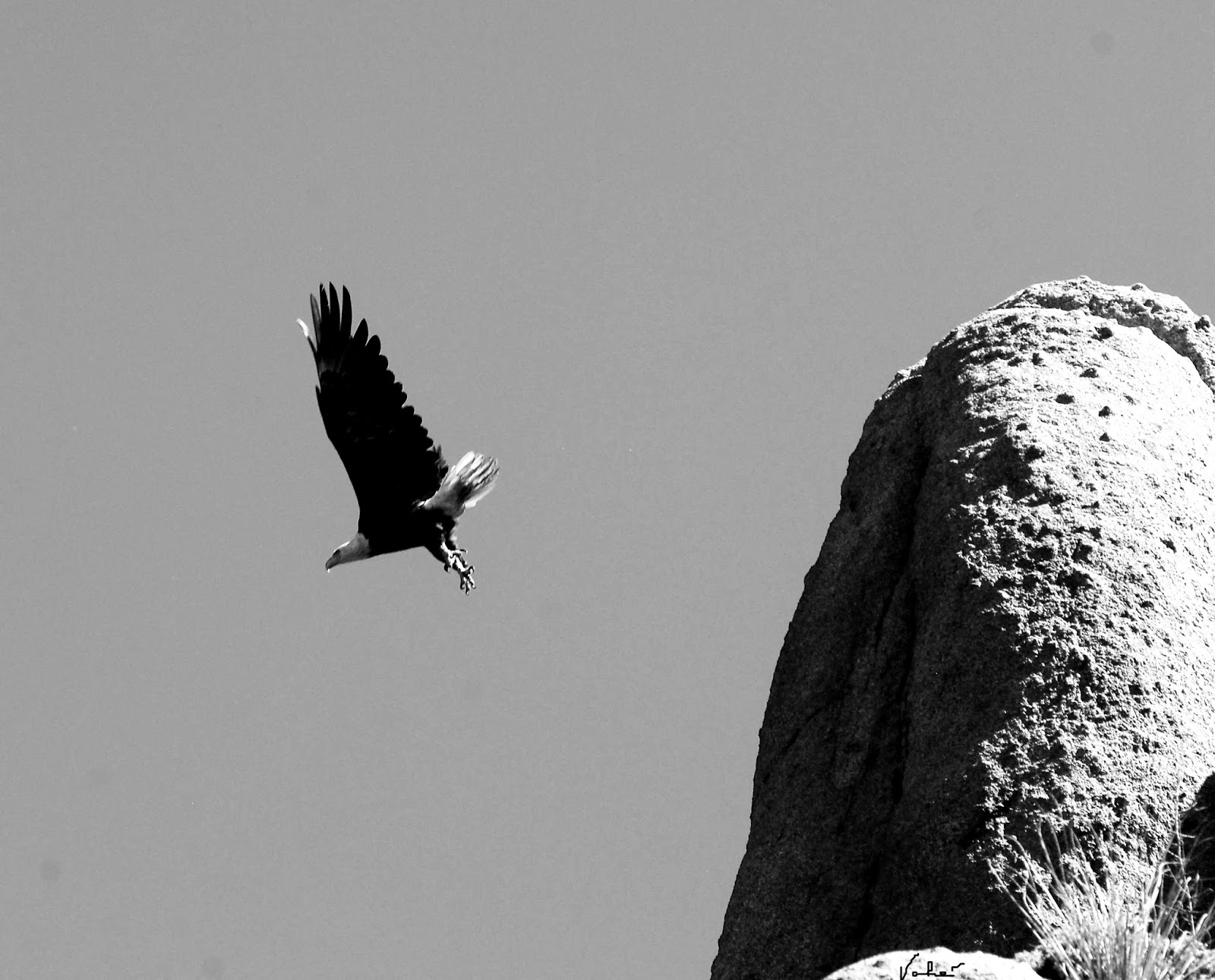
As I moved closer paddling gently, the eagle decided to take flight. I quickly shot two frames, hoping for the best. Here is the better of the two.


Upon closer inspection, I noticed his talons. I could not believe that they were so prominently captured. So I digitally enlarged the picture to show why the Bald Eagle is so unique in his posture and awe inspiring built.


Yet, he did not go far, and found a lonesome tree a few hundred meters away to perch and look at me. I paddled fast to get closer.


Finally, he flew away but not without allowing to take one more picture of the flight.


… I now wanted to get to shore, to my car, and quickly home. It was time to see what I had capture in that dark box of mine through the heavy, scratched but still “eagle-eyed” 50 year old telephoto!

May 30, 2015
© Vahé A. Kazandjian, 2015